Tuesday, December 31, 2013

Compare on-Page SEO of Two or More Pages (Featured SEO Tool)

This week in our “Featured tool” column we are sharing a neat online on-page SEO comparison tool that lets you quickly get an idea of how each of them is optimized and how the on-page tactics differ. Use the tool:


  • To grab top Google results competing with you and compare their on-page tactics

  • To compare your own pages if one seems to be performing better (for an unknown reason)


On-page SEO in numbers


The tool will give you a quick overview of basic on-page stats:


  • Words on each page;

  • “Linked” words on each page;

  • “Unlinked” words on each page;

  • Total links on each page;

  • Page size


basic on-page stats

Basic but essential numbers


Plus you’ll get a bird’s view of most essential meta tags (title and meta description)


(Sub)heading structure


Heading structure of each page (H1-H6 subheadings and their contents)


(Sub)heading structure

The overview of H1-H6 subheadings for each page


On-page keywords (Gold!)


Keyword usage of non-linked words on-page: one-, two- and three-word phrases (This one is gold for identifying ranking differences for internal pages!)


On-page keywords

Most frequent three-word combinations retrieved from each page


On-page links


The tool will list all links it could find on a page and break them into internal and external groups.


Finally the tool will provide you with the full CSS- and HTML-free text for all pages as well as full HTML code for each. Everything on one page!


Author information


The post Compare on-Page SEO of Two or More Pages (Featured SEO Tool) appeared first on SEO Chat.


Analyze Google SERPs with Smart Page Keyword Density Tool – Featured This Week!

Today’s featured tool is a smart keyword density analysis utility that you can use to analyze SERPs (search engine results pages)!


The steps:


  • Run a search on Google and copy-paste the results URL

  • Remove s from https of the URL (to make sure the tool can access it)

  • Add &num=100 to the results to make sure the tool has a ton of text to analyze

  • Run the URL through our tool


Suddenly you have the whole list of keyword suggestions to work with:


Google SERPs analysis

Google SERPs analysis


Mind that the tool takes all on-page content and analyzes keyword co-occurrence – which means you get a good glance of your core-term keyword context.


If you scroll a bit, you’ll see further analysis of non-linked content (which in this case means analysis of meta-descriptions and parts of the text Google thought was closest-related to your search term):


Analysis of non-linked part of Google SERPs


Awesome use of an old tool. Can think of any more?


Author information


The post Analyze Google SERPs with Smart Page Keyword Density Tool – Featured This Week! appeared first on SEO Chat.


My Must Have Tools of 2014


There are a lot of tools in the SEO space (sorry, couldn't resist :D) and over the years we've seen tools fall into 2 broad categories. Tools that aim to do just about everything and tools that focus on one discipline of online marketing.


As we continue to lose more and more data (not provided) and the data we have access to becomes a bit more unreliable (rankings, competitive research data, data given to us by search engines, etc) one has to wonder at what point does access to a variety of tools start producing diminishing returns?


In other words, if you are starting with unreliable or very, very inexact data does layering more and more extrapolations on top make you worse off than you were before? Probably.


I do think that a fair amount of tool usage scenarios have become less effective (or less necessary) at this point. Consider what were once the cornerstones of industry research and data:


  • Rankings

  • SERP difficulty analysis

  • Link prospecting

  • Competitive link research

  • Analytics


Each one of these areas of data has really taken a beating over the last 2-3 years thanks to collateral damage from broad-reaching, unforgiving Google updates, the loss of actual keyword data, the less obvious relationship between links and rankings, personalized search, various SERP layout changes, and on and on.


I believe the best way forward for evaluating what tools you should be using is to determine what does X best to the point where supplementing it with data from a similar provider is overkill and not worth the extra monthly subscription cost nor the cognitive overhead.


Which Ones to Choose?


Well, this certainly depends on what you do. I'm going to focus on the small to mid-size agency market (which also includes freelancers and folks who just operate their own properties) but for those tetering on mid-large size I'll make 2 recommendations based on personal experience:


If I were operating a bigger agency I'd strongly consider both of those. They both do a really solid job of providing customized reporting and research modules.


For the rest of us, I'll share what I'm using as a basis for my recommendations with reasons why I selected them.


These tools are focused on what I do on a daily basis and are the ones I simply cannot live without. They cover:


Reporting Competitive Link & Keyword Research Keyword Research PR and Outreach

Advanced Web Ranking


This is the tool I rely on the most. It does just about everything with the only drawbacks being the learning curve and that it is desktop software. The learning curve payoff is very much worth it though. This tool does the following for me:


  • Reporting for pretty much every aspect of a campaign

  • Interfaces with Majestic SEO for link data as well as data from Moz for link research and tracking

  • Connects to social accounts for reporting

  • Site audit crawls

  • Interfaces with Google Analytics

  • Keyword research

  • Competitor analysis

  • Rankings

  • On-page analysis


They have a cloud version for reporting and I believe that in the near future a good amount of this functionality will go to its cloud service. This tool is highly recommended.


Advanced Web Ranking - here's a basic overview of the software from a few years ago, though it has been updated a number of times since then


Ahrefs


I remember when this was for sale on Flippa! I find Ahrefs to be very reliable and easy to use. They have added quite a few features over the past year and, in my opinion, they are right up there with Majestic SEO when it comes to relevant, deep link data.


Their interface has improved dramatically over time and the constant addition of helpful, new features has left other tools playing catchup. I'm hoping to see more integration with them in 2014 via services like Raven and Advanced Web Ranking.


Ahrefs.com - here's a review from last year (though they no longer offer the SERP tracking feature they offered back then)


Authority Labs


The most accurate and stable online rankings provider I've used thus far. The interface has improved recently as has the speed of exports. I would still like to see a bulk PDF export of each individual site in the near future but overall my experience with Authority Labs has been great.


I use it as a stable, online, automated rank checker to supplement my data from Advanced Web Ranking. It also has some nice features like being able to track rankings from a zip code and showing what else is in the SERP it encounters (videos, snippets, etc).


Authority Labs - here's a review from 5 months ago


Buzzstream


Buzzstream is an absolute must have for anyone doing PR-based and social outreach. The email integration is fantastic and the folks that help me with outreach routinely rave about using Buzzstream.


The UI has really been turned up recently and the customer support has been excellent for us. I'm positive that our outreach would not be nearly has effective without Buzzstream and there really isn't a competing product out there that I've seen.


This is a good example of a really niche product that excels at its intended purpose.


Buzzstream - here's a review from a couple years ago


Citation Labs Suite


We use the Contact Finder, Link Prospector, and Broken Link Building tool inside our prospecting process. Much like Buzzstream this is a suite of tools that focuses on a core area and does it very well.


You have to spend some time with the prospector to get the best queries possible for your searches but the payoff is really relevant, quality link prospects.


Citation Labs - here's a review from a couple years ago


Link Research Tools


While LRT is primarily known for its Link Detox tool, this set of tools covers quite a bit of the SEO landscape. I do not use all the tools in the suite but the areas that I utilize LRT for are:


  • Link cleanup

  • Link prospecting

  • SERP competition analysis

  • Competitive domain comparisons


It's missing a few pieces but it is similar to Advanced Web Ranking in terms of power and data. LRT hooks into many third party tools (Majestic, SemRush, Moz, etc) so you get a pretty solid overview, in one place, of what you need to see or want to see.


The prospecting is similar, to an extent, when compared with Citation Labs but you can define specific SEO metrics to prospect filtering as well as base it off of links that appear across multiple sites in a given SERP.


LinkResearchTools


Majestic SEO


Majestic is still the defacto standard for deep link data (both fresh and historical data). They recently launched a new feature called Search Explorer, which is designed to be a specialized search engine devoid of personalization and what not, while showing rankings based on its interpretation of the web graph and how influential a site is for a given term.


As of this writing, Search Explorer is in Alpha but it does appear to be a really solid innovation from Majestic. The other reason for having a Majestic subscription is to get access to it's API so you can integrate the data however you choose to. I use it (access to the API) inside of LRT and Advanced Web Ranking.


Majestic SEO - here's a review from a couple years ago by Julie Joyce


Moz


I use Moz mainly for access to it's link data via Advanced Web Ranking. Compared to the other tools I use I do not see a ton of value in the rest of its tool suite and I also get data from it via my Raven subscription (which is where I tend to do a fair bit of research).


If you are on a tight budget it's worthy of consideration for the breadth of tools the subscription offers but I think you could get better options elsewhere if you have some budget to spread around.


Moz


Raven Tools


I don't use every single feature in Raven but I find Raven to be one of the most well-executed, stable tool suites on the market. I use Raven to:


  • Manage keyword lists

  • Research competitors

  • Manage and report on Twitter/Facebook profiles and campaigns

  • Track social mentions

  • Automate site crawls

  • Compare various, customizable metrics between sites

  • Google Analytics and Google/Bing Webmaster tools integration


In 2014 I'm looking to do more with Raven in the content management area and in the reporting area. I still prefer to supplement GWT rankings data with rankings data from another source (Advanced Web Ranking, Authority Labs, etc) but a goal for 2014, for me, is to fit more reporting into Raven's already excellent reporting engine.


Raven - here's a review from a few years ago


SemRush


In terms of keyword, ranking, and PPC competitive research tools SemRush really has moved ahead of the competition in the past year or so. I use most of the features in the suite:


  • Organic SEO Research

  • PPC keyword and strategy research

  • Multiple domain comparisons covering organic and paid search strategies

  • Yearly historical data feature on a specific domain


I also like the filtering feature(s) that really help me whittle down keyword data to exactly what I'm looking for without worrying about export limits and such.


SemRush - here's a review from a few years ago


SeoBook Community and Tools


Knowledge is power, naturally. All the tools in the world will not overcome a lack of knowledge. All of the specific, unbiased, actionable business & marketing knowledge that I've received over the last handul of years (and the relationships made) is the single most direct reason for any succcess I've had in this space.


The SeoBook Toolbar is still one of my most utilized tools. It is data source agnostic, you get data from a variety of sources quickly and reliably. Seo For Firefox takes most of the info in the toolbar and assigns it to each individual listing in a given SERP. Both tools are indispensible to me on the research front.


We also have some premium tools that I like quite a bit:


  • Local Rank - It scans up to 1,000 Google results and then cross-references links pointing from those sites to the top 10, 20, or 50 results for that same query. The tool operates on the premise that sites that are well linked to from other top ranked results might get an additional ranking boost on some search queries. You can read more about this in a Google patent here.

  • HubFinder - HubFinder looks for sites that have co-occuring links across up to 10 sites on a given topic. This is useful in finding authoritative links that link to competing sites in a given SERP.

  • Duplicate Content Checker - This Firefox extension scans Google for a given block of text to see if others are using the same content. The Duplicate Content Checker searches Google for each sentence wrapped in quotes and links to the results of the search.


Screaming Frog SEO Spider


This is my desktop crawler of choice for most sites, it's complimented by Raven's Site Auditor (which can be run automatically) and Advanced Web Ranking's site audit tool in my usage.


Just about anything you can think of from a site architecture and on-page standpoint can be done with this tool.


Screaming Frog - a few years ago Branko did a great review


TermExplorer


A cloud-based tool that processes large amounts of keywords pretty quickly and does a good job of bringing in terms from multiple sources.


It also offers a competitive analysis feature that I don't use very much as well as white-label reports. It has pretty slick filtering options for keywords and scans for exact match domains (.com and .net) in addition to CPC and keyword volume data.


Term Explorer


Avoid Tool Fatigue


There is going to be overlap across some of these tools and while the idea of all-in-one sounds nice it rarely works in practice. Clients are different, deliverables are different, and business models are different.


The trick is to avoid as much overlap as possible between the tools that you use, otherwise you end up wasting time, money, and resources by overthinking whatever it is that you are doing.


I have less than 20-ish toolsets that I use on an almost daily basis. Some of these are not used daily but definitely monthly. At one point I had access to over 40 different tools. The tools mentioned in this post are the ones that I've found the most value in and gained the most success from.


Should Venture Backed Startups Engage in Spammy SEO?


Here's a recent video of the founders of RapGenius talking at TechCrunch disrupt.


Oops, wrong video. Here's the right one. Same difference.


Recently a thread on Hacker News highlighted a blog post which pointed how RapGenius was engaging in reciprocal promotional arrangements where they would promote blogs on their Facebook or Twitter accounts if those bloggers would post a laundry list of keyword rich deeplinks at RapGenius.


Matt Cutts quickly chimed in on Hacker News "we're investigating this now."


A friend of mine and I were chatting yesterday about what would happen. My prediction was that absolutely nothing would happen to RapGenius, they would issue a faux apology, they would put no effort into cleaning up the existing links, and the apology alone would be sufficient evidence of good faith that the issue dies there.


Today RapGenius published a mea culpa where ultimately they defended their own spam by complaining about how spammy other lyrics websites are. The self-serving jackasses went so far as including this in their post: "With limited tools (Open Site Explorer), we found some suspicious backlinks to some of our competitors"


It's one thing to in private complain about dealing in a frustrating area, but it's another thing to publicly throw your direct competitors under the bus with a table of link types and paint them as being black hat spammers.


Google can't afford to penalize Rap Genius, because if they do Google Ventures will lose deal flow on the start ups Google co-invests in.


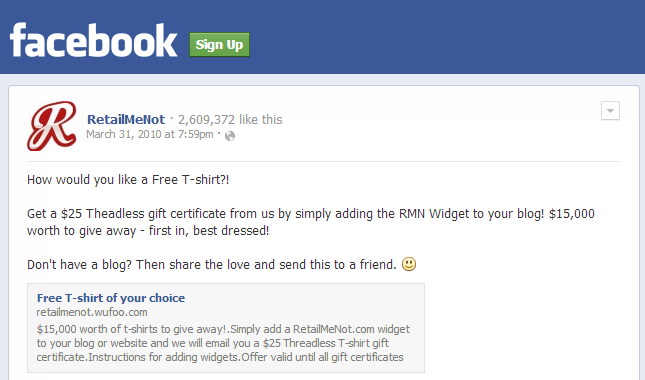
In the past some of Google's other investments were into companies that were pretty overtly spamming. RetailMeNot held multiple giveaways where if you embedded a spammy sidebar set of deeplinks to their various pages they gave you a free t-shirt:


Google's behavior on such arrangements has usually been to hit the smaller players while looking the other way on the bigger site on the other end of the transaction.


That free t-shirt for links post was from 2010 - the same year that Google invested in RetailMeNot. They did those promotions multiple times & long enough that they ran out of t-shirts! . Now that RTM is a publicly traded billion Dollar company which Google already endorsed by investing in, there's a zero percent chance of them getting penalized.


To recap, if you are VC-backed you can: spam away, wait until you are outed, when outed reply with a combined "we didn't know" and a "our competitors are spammers" deflective response.


For the sake of clarity, let's compare that string of events (spam, warning but no penalty, no effort needed to clean up, insincere mea culpa) to how a websites are treated when not VC backed. For smaller sites it is "shoot on sight" first and then ask questions later, perhaps coupled with a friendly recommendation to start over.


Here's a post from today highlighting a quote from Google's John Mueller:


My personal & direct recommendation here would be to treat this site as a learning experience from a technical point of view, and then to find something that you're absolutely passionate & knowledgeable about and create a website for that instead.

Growth hack inbound content marketing, but just don't call it SEO.


What's worse, is with the new fearmongering disavow promotional stuff, not only are some folks being penalized for the efforts of others, but some are being penalized for links that were in place BEFORE Google even launched as a company.


Given that money allegedly shouldn't impact rankings, its sad to note that as everything that is effective gets labeled as spam, capital and connections are the key SEO innovations in the current Google ecosystem.


Beware Of SEO Truthiness


When SEO started, many people routinely used black-box testing to try any figure out what pages the search engines rewarded.


Black box testing is terminology used in IT. It’s a style of testing that doesn’t assume knowledge of the internal workings of a machine or computer program. Rather, you can only test how the system responds to inputs.


So, for many years, SEO was about trying things out and watching how the search engine responded. If rankings went up, SEOs assumed correlation meant causation, so they did a lot more of whatever it was they thought was responsible for the boost. If the trick was repeatable, they could draw some firmer conclusions about causation, at least until the search engine introduced some new algorithmic code and sent everyone back to their black-box testing again.


Well, it sent some people back to testing. Some SEO’s don’t do much, if any, testing of their own, and so rely on the strategies articulated by other people. As a result, the SEO echo chamber can be a pretty misleading place as “truthiness” - and a lot of false information - gets repeated far and wide, until it’s considered gospel. One example of truthiness is that paid placement will hurt you. Well, it may do, but not having it may hurt you more, because it all really…..depends.


Another problem is that SEO testing can seldom be conclusive, because you can’t be sure of the state of the thing you’re testing. The thing you're testing may not be constant. For example, you throw up some more links, and your rankings rise, but the rise could be due to other factors, such as a new engagement algorithm that Google implemented in the middle of your testing, you just didn’t know about it.


It used to be a lot easier to conduct this testing. Updates were periodic. Up until that point, you could reasonably assume the algorithms were static, so cause and effect were more obvious than they are today. Danny Sullivan gave a good overview of search history at Moz earlier in the year:


That history shows why SEO testing is getting harder. There are a lot more variables to isolate that there used to be. The search engines have also been clever. A good way to thwart SEO black box testing is to keep moving the target. Continuously roll out code changes and don’t tell people you’re doing it. Or send people on a wild goose chase by arm-waving about a subtle code change made over here, when the real change has been made over there.


That’s the state of play in 2013.


However….(Ranting Time :)


Some SEO punditry is bordering on the ridiculous!


I’m not going to link to one particular article I’ve seen recently, as, ironically, that would mean rewarding them for spreading FUD. Also, calling out people isn't really the point. Suffice to say, the advice was about specifics, such as how many links you can “safely” get from one type of site, that sort of thing....


The problem comes when we can easily find evidence to the contrary. In this case, a quick look through the SERPs and you'll find evidence of top ranking sites that have more than X links from Site Type Y, so this suggests….what? Perhaps these sites are being “unsafe”, whatever that means. A lot of SEO punditry is well meaning, and often a rewording of Google's official recommendations, but can lead people up the garden path if evidence in the wild suggests otherwise.


If one term defined SEO in 2013, it is surely “link paranoia”.


What's Happening In The Wild


When it comes to what actually works, there are few hard and fast rules regarding links. Look at the backlink profiles for top ranked sites across various categories and you’ll see one thing that is constant....


Nothing is constant.


Some sites have links coming from obviously automated campaigns, and it seemingly doesn’t affect their rankings. Other sites have credible link patterns, and rank nowhere. What counts? What doesn’t? What other factors are in play? We can only really get a better picture by asking questions.


Google allegedly took out a few major link networks over the weekend. Anglo Rank came in for special mention from Matt Cutts.


So, why are Google making a point of taking out link networks if link networks don’t work? Well, it’s because link networks work. How do we know? Look at the back link profiles in any SERP area where there is a lot of money to be made, and the area isn’t overly corporate i.e. not dominated by major brands, and it won’t be long before you spot aggressive link networks, and few "legitimate" links, in the backlink profiles.


Sure, you wouldn't want aggressive link networks pointing at brand sites, as there are better approaches brand sites can take when it comes to digital marketing, but such evidence makes a mockery of the tips some people are freely handing out. Are such tips the result of conjecture, repeating Google's recommendations, or actual testing in the wild? Either the link networks work, or they don’t work but don’t affect rankings, or these sites shouldn't be ranking.


There’s a good reason some of those tips are free, I guess.


Risk Management


Really, it’s a question of risk.


Could these sites get hit eventually? Maybe. However, those using a “disposable domain” approach will do anything that works as far as linking goes, as their main risk is not being ranked. Being penalised is an occupational hazard, not game-over. These sites will continue so long as Google's algorithmic treatment rewards them with higher ranking.


If your domain is crucial to your brand, then you might choose to stay away from SEO entirely, depending on how you define “SEO”. A lot of digital marketing isn’t really SEO in the traditional sense i.e. optimizing hard against an algorithm in order to gain higher rankings, a lot of digital marketing is based on optimization for people, treating SEO as a side benefit. There’s nothing wrong with this, of course, and it’s a great approach for many sites, and something we advocate. Most sites end up somewhere along that continuum, but no matter where you are on that scale, there’s always a marketing risk to be managed, with perhaps "non-performance" being a risk that is often glossed over.


So, if there's a take-away, it's this: check out what actually happens in the wild, and then evaluate your risk before emulating it. When pundits suggest a rule, check to see if you can spot times it appears to work, and perhaps more interestingly, when it doesn't. It's in those areas of personal inquiry and testing where gems of SEO insight are found.


SEO has always been a mix of art and science. You can test, but only so far. The art part is dealing with the unknown past the testing point. Performing that art well is to know how to pick truthiness from reality.


And that takes experience.


But mainly a little fact checking :)


Value Based SEO Strategy


One approach to search marketing is to treat the search traffic as a side-effect of a digital marketing strategy. I’m sure Google would love SEOs to think this way, although possibly not when it comes to PPC! Even if you’re taking a more direct, rankings-driven approach, the engagement and relevancy scores that come from delivering what the customer values should serve you well, too.


In this article, we’ll look at a content strategy based on value based marketing. Many of these concepts may be familiar, but bundled together, they provide an alternative search provider model to one based on technical quick fixes and rank. If you want to broaden the value of your SEO offering beyond that first click, and get a few ideas on talking about value, then this post is for you.


In any case, the days of being able to rank well without providing value beyond the click are numbered. Search is becoming more about providing meaning to visitors and less about providing keyword relevance to search engines.


What Is Value Based Marketing?


Value based marketing is customer, as opposed to search engine, centric. In Values Based Marketing For Bottom Line Success, the authors focus on five areas:


  • Discover and quantify your customers' wants and needs

  • Commit to the most important things that will impact your customers

  • Create customer value that is meaningful and understandable

  • Assess how you did at creating true customer value

  • Improve your value package to keep your customers coming back


Customers compare your offer against those of competitors, and divide the benefits by the cost to arrive at value. Marketing determines and communicates that value.


This is the step beyond keyword matching. When we use keyword matching, we’re trying to determine intent. We’re doing a little demographic breakdown. This next step is to find out what the customer values. If we give the customer what they value, they’re more likely to engage and less likely to click back.


What Does The Customer Value?


A key question of marketing is “which customers does this business serve”? Seems like an obvious question, but it can be difficult to answer. Does a gym serve people who want to get fit? Yes, but then all gyms do that, so how would they be differentiated?


Obviously, a gym serves people who live in a certain area. So, if our gym is in Manhattan, our customer becomes “someone who wants to get fit in Manhattan”. Perhaps our gym is upmarket and expensive. So, our customer becomes “people who want to get fit in Manhattan and be pampered and are prepared to pay more for it”. And so on, and so on. They’re really questions and statements about the value proposition as perceived by the customer, and then delivered by the business.


So, value based marketing is about delivering value to a customer. This syncs with Google’s proclaimed goal in search, which is to put users first by delivering results they deem to have value, and not just pages that match a keyword term. Keywords need to be seen in a wider context, and that context is pretty difficult to establish if you’re standing outside the search engine looking in, so thinking in terms of concepts related to the value proposition might be a good way to go.


Value Based SEO Strategy


The common SEO approach, for many years, has started with keywords. It should start with customers and the business.


The first question is “who is the target market” and then ask what they value.


Relate what they value to the business. What is the value proposition of the business? Is it aligned? What would make a customer value this business offering over those of competitors? It might be price. It might be convenience. It’s probably a mix of various things, but be sure to nail down the specific value propositions.


Then think of some customer questions around these value propositions. What would be the likely customer objections to buying this product? What would be points that need clarifying? How does this offer differ from other similar offers? What is better about this product or service? What are the perceived problems in this industry? What are the perceived problems with this product or service? What is difficult or confusing about it? What could go wrong with it? What risks are involved? What aspects have turned off previous customers? What complaints did they make?


Make a list of such questions. These are your article topics.


You can glean this information by either interviewing customers or the business owner. Each of these questions, and accompanying answer, becomes an article topic on your site, although not necessarily in Q&A format. The idea is to create a list of topics as a basis for articles that address specific points, and objections, relating to the value proposition.


For example, buying SEO services is a risk. Customers want to know if the money they spend is going to give them a return. So, a valuable article might be a case study on how the company provided return on spend in the past, and the process by which it will achieve similar results in future. Another example might be a buyer concerned about the reliability of a make of car. A page dedicated to reliability comparisons, and another page outlining the customer care after-sale plan would provide value. Note how these articles aren’t keyword driven, but value driven.


Ever come across a FAQ that isn’t really a FAQ? Dreamed-up questions? They’re frustrating, and of little value if the information doesn’t directly relate to the value we seek. Information should be relevant and specific so when people land on the site, there’s more chance they will perceive value, at least in terms of addressing the questions already on their mind.


Compare this approach with generic copy around a keyword term. A page talking about “SEO” in response to the keyword term “SEO“might closely match a keyword term, so that’s a relevance match, but unless it’s tied into providing a customer the value they seek, it’s probably not of much use. Finding relevance matches is no longer a problem for users. Finding value matches often is. Even if you’re keyword focused, added these articles provides you semantic variation that may capture keyword searches that aren't appearing in keyword tools.


Keyword relevance was a strategy devised at a time when information was less readily available and search engines weren't as powerful. Finding something relevant was more hit and miss that it is today. These days, there’s likely thousands, if not millions, of pages that will meet relevance criteria in terms of keyword matching, so the next step is to meet value criteria. Providing value is less likely to earn a click back and more likely to create engagement than mere on-topic matching.


The Value Chain


Deliver value. Once people perceive value, then we have to deliver it. Marketing, and SEO in particular, used to be about getting people over the threshold. Today, businesses have to work harder to differentiate themselves and a sound way of doing this is to deliver on promises made.


So the value is in the experience. Why do we return to Amazon? It’s likely due to the end-to-end experience in terms of delivering value. Any online e-commerce store can deliver relevance. Where competition is fierce, Google is selective.


In the long term, delivering value should drive down the cost of marketing as the site is more likely to enjoy repeat custom. As Google pushes more and more results beneath the fold, the cost of acquisition is increasing, so we need to treat each click like gold.


Monitor value. Does the firm keep delivering value? To the same level? Because people talk. They talk on Twitter and Facebook and the rest. We want them talking in a good way, but even if they talk in a negative way, it can still useful. Their complaints can be used as topics for articles. They can be used to monitor value, refine the offer and correct problems as they arise. Those social signals, whilst not a guaranteed ranking boost, are still signals. We need to adopt strategies whereby we listen to all the signals, so to better understand our customers, in order to provide more value, and hopefully enjoy a search traffic boost as a welcome side-effect, so long as Google is also trying to determine what users value. .


Not sounding like SEO? Well, it’s not optimizing for search engines, but for people. If Google is to provide value, then it needs to ensure results provide not just relevant, but offer genuine value to end users. Do Google do this? In many cases, not yet, but all their rhetoric and technical changes suggest that providing value is at the ideological heart of what they do. So the search results will most likely, in time, reflect the value people seek, and not just relevance.


In technical terms, this provides some interesting further reading:


Today, signals such as keyword co-occurrence, user behavior, and previous searches do in fact inform context around search queries, which impact the SERP landscape. Note I didn’t say the signals “impact rankings,” even though rank changes can, in some cases, be involved. That’s because there’s a difference. Google can make a change to the SERP landscape to impact 90 percent of queries and not actually cause any noticeable impact on rankings.


The way to get the context right, and get positive user behaviour signals, and align with their previous searches, is to first understand what people value.


Creating an Experience for Your Product


In a recent post I talked about the benefits of productizing your business model along with some functional ways to achieve productization.


A product, in and of itself is really only 1/2 of what you are selling to your clients. The other 1/2 of the equation is the "experience".


It sounds a bit "fluffy" but in my career as a service provider and in my purchasing history as a consumer the experience matters. I would even go so far as to say that in some very noticeable cases the experience can outweigh the product itself (to some extent anyways).


These halves, the product and the experience, can cut both ways.


Sometimes a product is so good that the experience can be average or even below average and the provider will still make out and sometimes the experience is so fantastic that an otherwise average or above average product is elevated to what can be priced as a premium product or service.


Let's get a few obvious variables out of the way first. It is understood that:


  1. Experience matters more to some people than others

  2. Experience matters more in certain industries than others

  3. The actual product matters more to some

  4. The actual product matters more in some industries


If we stipulate that the 4 scenarios mentioned above are true, which they are, it still doesn't change the basic premise that you are probably leaving revenue and growth on the table if you settle on one side or the other.


While it's true that you can be successful even if your product to experience ratio is like a seesaw heavily weighted in one direction over the other, it is also true that you would probably be more successful if you made both the best each could be.


Defining Where Product Meets Experience


I'll layout a couple of examples here to help illustrate the point:


  • The "Big Four" in the link research tools space; Ahrefs, Link Research Tools, Majestic, and Open Site Explorer

  • The two more well-known "tool/reporting suites" Raven and Moz outside of much more expensive enterprise toolkits


In my experience Ahrefs has been the best combination of product and experience, especially lately. Their dataset continues to grow and recent UI changes have made it even easier to use. Exports are super fast and I’ve had quick and useful interactions with their support staff. Perhaps it isn’t a coincidence that, from groups of folks I interact with and follow online, Ahrefs continues to pop up more often in conversation than not.


To me, Majestic and Link Research Tools are examples of where the product is really, really strong (copious amounts of data across many segments) but the UI/UX is not quite as good as the others. I realize some of this is subjective but in other comparisons online this seems to be a prevailing theme.


Open Site Explorer has a fantastic UI/UX but the data can be a bit behind the others and getting data out (exporting) is bit more of a chore than point, click, download. It seems like over a period of time OSE has had a rougher road to data and update growth than the other tools I mentioned.


In the case of two of more popular reporting and research suites, Moz and Raven, Raven has really caught up (if not surpassed) Moz in terms of UI/UX. Raven pulls in data from multiple sources, including Moz, and has quite a few more (and easier to get to and cross-reference) features than Moz.


Moz may not be interested in getting into some of the other pieces of the online marketing puzzle that Raven is into but I think it’s still a valid comparison based on the very similar, basic purpose of each tool suite.


Assessing Your Current Position


When assessing or reassessing your products and offerings, a lot of it goes back to targeting the right market.


  • Is the market big enough to warrant investment into a product?

  • How many different segments of a given market do you need to appeal to?

  • Where’s the balance between feature bloat (think Zoho CRM) versus “good enough” functionality with an eye towards an incredible UX (think Highrise CRM)?


If the market isn’t big enough and you have to go outside your initial target, how will that affect the balance between the functionality of your product and the experience for your users, customers, or clients?


If you are providing SEO services your "functionality" might be how easy it is to determine the reports you provide and their relationship(s) to a client's profitability or goals (or both). Your "experience" is likely a combination of things:


  • The graphical presentation of your documents

  • The language used in your reports and other interactions with the client

  • The consistency of your "brand" across the web

  • The consistency of your brand presentation (website, invoices, reports, etc)

  • Client ability to access reports and information quickly without having to ask you for it

  • Consistency of your information delivery (are you always on-time, late, or erratic with due dates, meetings, etc)


When you breakdown what you think is your "product" and "experience" you'll likely find that it is pretty simple to develop a plan to improve both, rather than beating the vague "let's do great things" company line that no one really understands but just nods at.


Example of Experience in Action


In just about every Consumer Reports survey Apple comes out on top for customer satisfaction. Apple, whether you like their products/"culture" or not, creates a fairly reliable, if not expensive, end to end experience. This is doubly true if you live near an Apple store.


If you look at laptop failure rates Apple is generally in the middle of the pack. There are other things that go into the Apple experience (using the OS and such) but part of the reason people are willing to pay that premium is due to their support options and ability to fix bugs fairly quickly.


To tie this into our industry, I think Moz is a good parallel example here. Their design is generally heralded as being quite pleasant and it's pretty easy to use their tools; there isn't a steep learning curve to using most of their products.


I think their product presentation is top notch, even though I generally prefer some of their competitors products. They are pretty active on social media and their support is generally very good.


So, in the case of Moz it's pretty clear that people are willing to pay for less robust data or at least less features and options partly (or wholly) due to their product experience and product presentation.


Redesigning Your Experience


You might already have some of these but it's worthwhile to revisit a very basic style guide (excluding audience development):


  • Consistent logo and colors

  • Fonts

  • Vocabulary and Language Style (the tone of your brand, is it My Brand or MyBrand or myBrand, etc)


Some Additional Resources


Here are some visual/text-based resources that I have found helpful during my own redefining process:


These are some of the tools you might want to use to help in this process:


  • Running copy through Word for readability Scores- Office 2013

  • A Windows tool that can help improve your writing- Stylewriter

  • A Mac tool to help with graphics and charts- Omnigraffle

  • A Windows tool to help with charts and graphics- SmartDraw

  • A cloud-based presentation tool that helps the less artistically inclined (like me)- Prezi

  • Online proposal software- Proposable

  • A text expander for Mac, comes in handy with consistent "messaging"- TextExpander

  • Windows alternative that syncs with TextExpander- Breevy


Historical Revisionism


A stopped clock is right two times a day.


There’s some amusing historical revisionism going on in SEO punditry world right now, which got me thinking about the history of SEO. I’d like to talk about some common themes of this historical revision, which goes along the lines of “what I predicted all those years ago came true - what a visionary I am! ." No naming names, as I don't meant this to be anything personal - as the same theme has popped up in a number of places - just making some observations :)


See if you agree….


Divided We Fall


The SEO world has never been united. There are no industry standards and qualifications like you’d find in the professions, such as being a doctor, or lawyer or a builder. If you say you’re an SEO, then you’re an SEO.


Part of the reason for the lack of industry standard is that the search engines never came to the party. Sure, they talked at conferences, and still do. They offered webmasters helpful guidelines. They participated in search engine discussion forums. But this was mainly to do with risk management. Keep your friends close, and your enemies closer.


In all these years, you won’t find one example of a representative from a major search engine saying “Hey, let’s all get together and form an SEO standard. It will help promote and legitimize the industry!”.


No, it has always been decrees from on high. “Don’t do this, don’t do that, and here are some things we’d like you to do”. Webmasters don’t get a say in it. They either do what the search engines say, or they go against them, but make no mistake, there was never any partnership, and the search engines didn’t seek one.


This didn’t stop some SEOs seeing it as a form of quasi-partnership, however.


Hey Partner


Some SEOs chose to align themselves with search engines and do their bidding. If the search engine reps said “do this”, they did it. If the search engines said “don’t do this”, they’d wrap themselves up in convoluted rhetorical knots pretending not to do it. This still goes on, of course.


In the early 2000’s, it turned, curiously, into a question of morality. There was “Ethical SEO”, although quite what it had to do with ethics remains unclear. Really, it was another way of saying “someone who follows the SEO guidelines”, presuming that whatever the search engines decree must be ethical, objectively good and have nothing to do self-interest. It’s strange how people kid themselves, sometimes.


What was even funnier was the search engine guidelines were kept deliberately vague and open to interpretation, which, of course, led to a lot of heated debate. Some people were “good” and some people were “bad”, even though the distinction was never clear. Sometimes it came down to where on the page someone puts a link. Or how many times someone repeats a keyword. And in what color.


It got funnier still when the search engines moved the goal posts, as they are prone to do. What was previously good - using ten keywords per page - suddenly became the height of evil, but using three was “good” and so all the arguments about who was good and who wasn’t could start afresh. It was the pot calling the kettle black, and I’m sure the search engines delighted in having the enemy warring amongst themselves over such trivial concerns. As far as the search engines were concerned, none of them were desirable, unless they became paying customers, or led paying customers to their door. Then there was all that curious Google+ business.


It's hard to keep up, sometimes.


Playing By The Rules


There’s nothing wrong with playing by the rules. It would have been nice to think there was a partnership, and so long as you followed the guidelines, high rankings would naturally follow, the bad actors would be relegated, and everyone would be happy.


But this has always been a fiction. A distortion of the environment SEOs were actually operating in.


Jason Calacanis, never one to miss an opportunity for controversy, fired some heat seekers at Google during his WebmasterWorld keynote address recently…..


Calacanis proceeded to describe Cutts and Google in terms like, “liar,” “evil,” and “a bad partner.” He cautioned the PubCon audience to not trust Google, and said they cooperate with partners until they learn the business and find a way to pick off the profits for themselves. The rant lasted a good five minutes….


He accused Google of doing many of the things SEOs are familiar with, like making abrupt algorithm changes without warning. They don’t consult, they just do it, and if people’s businesses get trashed as a result, then that’s just too bad. Now, if that’s a sting for someone who is already reasonably wealthy and successful like Calacanis, just imagine what it feels like for the much smaller web players who are just trying to make a living.


The search business is not a pleasant environment where all players have an input, and then standards, terms and play are generally agreed upon. It’s war. It’s characterized by a massive imbalance of power and wealth, and one party will use it to crush those who it determines stands in its way.


Of course, the ever pleasant Matt Cutts informs us it’s all about the users, and that’s a fair enough spin of the matter, too. There was, and is, a lot of junk in the SERPs, and Mahalo was not a partner of Google, so any expectation they’d have a say in what Google does is unfounded.


The take-away is that Google will set rules that work for Google, and if they happen to work for the webmaster community too, well that’s good, but only a fool would rely on it. Google care about their bottom line and their projects, not ours. If someone goes out of business due to Google’s behaviour, then so be it. Personally, I think the big technology companies do have a responsibility beyond themselves to society, because the amount of power they are now centralising means they’re not just any old company anymore, but great vortexes that can distort entire markets. For more on this idea, and where it’s all going, check out my review of “Who Owns The Future” by Jaron Lanier.


So, if you see SEO as a matter of playing by their rules, then fine, but keep in mind "those who can give you everything can also take everything away". Those rules weren't designed for your benefit.


Opportunity Cost


There was a massive opportunity cost by following so called ethical SEO during the 2000s.


For a long time, it was relatively easily to get high rankings by being grey. And if you got torched, you probably had many other sites with different link patterns good to go. This was against the webmaster guidelines, but given marketing could be characterized as war, one does not let the enemy define ones tactics. Some SEOs made millions doing it. Meanwhile, a lot of content-driven sites disappeared. That was, perhaps, my own "a stopped clock is right two times a day" moment. It's not like I'm going to point you to all the stuff I've been wrong about, now is it :)


These days, a lot of SEO is about content and how that content is marketed, but more specifically it’s about the stature of the site on which that content appears. That’s the bit some pundits tend to gloss over. You can have great content, but that’s no guarantee of anything. You will likely remain invisible. However, put that exact same content on a Fortune 500 site, and that content will likely prosper. Ah, the rich get richer.


So, we can say SEO is about content, but that’s only half the picture. If you’re a small player, the content needs to appear in the right place, be very tightly targeted to your audiences needs so they don’t click back, and it should be pushed through various media channels.


Content, even from many of these "ethical SEOs", used to be created for search engines in the hope of netting as many visitors as possible. These days, it’s probably a better strategy to get inside the audience's heads and target it to their specific needs, as opposed to a keyword, then get that content out to wherever your audience happens to be. Unless, of course, you’re Fortune 500 or otherwise well connected, in which case you can just publish whatever you like and it will probably do well.


Fair? Not really, but no one ever said this game was fair.


Whatever Next?


Do I know what’s going to happen next? In ten years time? Nope. I could make a few guesses, and like many other pundits, some guesses will prove right, and some will be wrong, but that’s the nature of the future. It will soon make fools of us all.


Having said that, will you take a punt and tell us what you think will be the future of SEO? Does it have one? What will look like? If you’re right, then you can point back here in a few years time and say “Look, I told you so!”.


If you’re wrong, well, there’s always historical revisionism :)


Optimizing The SEO Model


SEO has always been focused on acquisition.


The marketing strategy, based on high rankings against keyword terms, is about gaining a steady flow of new visitors. If a site ranks better than competing sites, this steady stream of new visitors will advantage the top sites to the disadvantage of those sites beneath it.


The selling point of SEO is a strong one. The client gets a constant flow of new visitors and enjoys competitive advantage, just so long as they maintain rank.


A close partner of SEO is PPC. Like SEO, PPC delivers a stream of new visitors, and if you bid well, and have relevant advertisements, then you enjoy a competitive advantage. Unlike PPC, SEO does not cost per click, or, to be more accurate, it should cost a lot less per click once the SEOs fees are taken into account, so SEO has enjoyed a stronger selling point. Also, the organic search results typically have a higher level of trust from search engine users.


91% prefer using natural search results when looking to buy a product or service online".[Source: Tamar Search Attitudes Report, Tamar, July 2010]


Rain On The Parade


Either by coincidence or design, Google’s algorithm shifts have made SEO less of a sure proposition.


If you rank well, the upside is still there, but because the result is less certain than it used to be, and the work more involved than ever, the risk, and costs in general, have increased. The more risky SEO becomes in terms of getting results, the more Adwords looks attractive, as at least results are assured, so long as spend is sufficient.


Adwords is a brilliant system. For Google. It’s also a brilliant system for those advertisers who can find a niche that doesn’t suffer high levels of competition. The trouble is competition levels are typically high.


Because competition is high, and Adwords is an auction model, bid prices must rise. As bid prices rise, only those companies that can achieve ROI at high costs per click will be left bidding. The higher their ROI, the higher the bid prices can conceivably go. Their competitors, if they are to keep up, will do likewise.


So, the PPC advertiser focused on customer acquisition as a means of growing the company will be passing more and more of their profits to Google in the form of higher and higher click prices. If a company wants to grow by customer acquisition, via the search channel, then they’ll face higher and higher costs. It can be difficult to maintain ROI via PCC over time, which is why SEO is appealing. It’s little wonder Google has their guns pointed at SEO.


A fundamental problem with Adwords, and SEO in general, is that basing marketing success around customer acquisition alone is a poor long term strategy.


More on that point soon….


White-Hat SEO Is Dead


It’s surprising a term such as “white hat SEO” was ever taken seriously.


Any attempt to game a search engine’s algorithm, as far as the search engine is concerned, is going to be frowned upon by the search engine. What is gaming if it’s not reverse engineering the search engines ranking criteria and looking to gain a higher rank than a site would otherwise merit? Acquiring links, writing keyword-focused articles, for the purpose of gaining a higher rank in a search engine is an attempt at rank manipulation. The only thing that varies is the degree.


Not that there’s anything wrong with that, as far as marketers are concerned.


The search marketing industry line has been that so long as you avoided “bad behaviour”, your site stood a high chance of ranking well. Ask people for links. Find keywords with traffic. Publish pages focused on those topics. There used to more certainty of outcome.


If the outcome is not assured, then so long as a site is crawlable, why would you need an SEO? You just need to publish and see where Google ranks you. Unless the SEO is manipulating rank, then where is the value proposition over and above simply publishing crawlable content? Really, SEO is a polite way of saying “gaming the system”.


Those who let themselves be defined by Google can now be seen scrambling to redefine themselves. “Inbound marketers” is one term being used a lot. There’s nothing wrong with this, of course, although you’d be hard pressed to call it Search Engine Optimization. It’s PR. It’s marketing. It’s content production. The side effect of such activity might be a high ranking in the search engines (wink, wink). It’s like Fight Club. The first rule of Fight Club is…...


A few years back, we predicted that the last SEOs standing would be blackhat, and that’s turned out to be true. The term SEO has been successfully co-opted and marginalized. You can still successfully game the system with disposable domains, by aggressively targeting keywords, and buying lot of links and/or building link networks, but there’s no way that’s compliant with Google’s definitions of acceptable use. It would be very difficult to sell that to a client without full disclosure. Even with full disclosure, I’m sure it’s a hard sell.


But I digress….


Optimization In The New Environment


The blackhats will continue on as usual. They never took direction from search engines, anyway.


Many SEOs are looking to blend a number of initiatives together to take the emphasis off search. Some call it inbound. In practice, it blends marketing, content production and PR. It's a lot less about algo hacking.


For it to work well, and to get great results in search, the SEO model needs to be turned on its head. It’s still about getting people to a site, but because the cost of getting people to a site has increased, every visitor must count. For this channel to maintain value, then more focus will go on what happens after the click.


If the offer is not right, and the path to that offer isn’t right, then it’s like having people turn up for a concert when the band hasn’t rehearsed. At the point the audience turns up, they must deliver what the audience wants, or the audience isn’t coming back. The bands popularity will quickly fade.


This didn’t really matter too much in the past when it was relatively cheap to position in the SERPs. If you received a lot of slightly off-topic traffic, big deal, it’s not like it cost anything. Or much. These days, because it’s growing ever more costly to position, we’re increasingly challenged by the “growth by acquisition” problem.


Consider optimizing in two areas, if you haven’t already.


1. Offer Optimization


We know that if searchers don’t find what they what, they click back. The click back presents two problems. One, you just wasted time and money getting that visitor to your site. Secondly, it’s likely that Google is measuring click-backs in order to help determine relevancy.


How do you know if your offer is relevant to users?


The time-tested way is to examine a couple of the 4ps. Product, price, position, and place. Place doesn’t matter so much, as we’re talking about the internet, although if you’ve got some local-centric product or service, then it’s a good idea to focus on it. Promotion is what SEOs do. They get people over the threshold.


However, two areas worth paying attention to are product and price. In order to optimize product, we need to ask some fundamental questions:


  • Does the customer want this product or service?

  • What needs does it satisfy? Is this obvious within a few seconds of viewing the page?

  • What features does it have to meet these needs? Are these explained?

  • Are there any features you've missed out? Have you explained all the features that meet the need?

  • Are you including costly features that the customer won't actually use?

  • How and where will the customer use it?

  • What does it look like? How will customers experience it?

  • What size(s), color(s) should it be?

  • What is it to be called?

  • How is it branded?

  • How is it differentiated versus your competitors?

  • What is the most it can cost to provide, and still be sold sufficiently profitably?


SEOs are only going to have so much control over these aspects, especially if they’re working for a client. However, it still pays to ask these questions, regardless. If the client can’t answer them, then you may be dealing with a client who has no strategic advantage over competitors. They are likely running a me-too site. Such sites are difficult to position from scratch.


Even older sites that were at one point highly differentiated have slid into an unprofitable me too status as large sites like Amazon & eBay offer a catalog which grows deeper by the day.


Unless you're pretty aggressive, taking on me-too sites will make your life difficult in terms of SEO, so thinking about strategic advantage can be a good way to screen clients. If they have no underlying business advantage, ask yourself if you really want to be doing SEO for these people?


In terms of price:


  • What is the value of the product or service to the buyer?

  • Are there established price points for products or services in this area?

  • Is the customer price sensitive? Will a small decrease in price gain you extra market share? Or will a small increase be indiscernible, and so gain you extra profit margin?

  • What discounts should be offered to trade customers, or to other specific segments of your market?

  • How will your price compare with your competitors?


Again, even if you have little or no control over these aspects, then it still pays to ask the questions. You're looking for underlying business advantage that you can leverage.


Once we’ve optimized the offer, we then look at conversion.


2. Conversion Optimization


There’s the obvious conversion most search marketers know about. People arrive at a landing page. Some people buy what’s on offer, and some leave. So, total conversions/number of views x 100 equals the conversion rate.


However, when it comes to SEO, it’s not just about the conversion rate of a landing page. Unlike PPC, you don’t have precise control over the entry page. So, optimizing for conversion is about looking at every single page on which people enter your site, and optimizing each page as if it were an entry point.


What do you want people to do when they land on your page?


Have a desired action in mind for every page. It might be a sign-up. It might be to encourage a bookmark. It might be to buy something. It might be to tweet. Whatever it is, we need to make the terms of engagement, for the visitor, clear for each page - with a big, yellow highlight on the term “engagement”! Remember, Google are likely looking at bounce-back rates. So, there is a conversion rate for every single page on your site, and they’re likely all different.


Think about the shopping cart process. Is a buyer, particularly a mobile buyer, going to wade through multiple forms? Or could the sale be made in as few clicks as possible? Would integrating Paypal or Amazon payments lift your conversion rates? What’s your site speed like? The faster, the better, obviously. A lot of conversion is about streamlining things - from processes, to navigation to site speed.


At this point, a lot of people will be wondering how to measure and quantify all this. How to track track conversion funnels across a big site. It’s true, it’s difficult. It many cases, it’s pretty much impossible to get adequate sample sizes.


However, that’s not a good reason to avoid conversion optimization. You can measure it in broad terms, and get more incremental as time goes on. A change across pages, a change in paths, can lead to small changes on those pages and paths, even changes that are difficult to spot, but there is sufficient evidence that companies who employ conversion optimization can enjoy significant gains, especially if they haven't focused on these areas in the past.


While you could quantify every step of the way, and some companies certainly do, there’s probably a lot of easy wins that can be gained merely by following these two general concepts - optimizing the offer and then optimizing (streamlining) the pages and paths that lead to that offer. If something is obscure, make it obvious. If you want the visitor to do something, make sure the desired action is writ-large. If something is slow, make it faster.


Do it across every offer, page and path in your site and watch the results.


Productizing Your SEO Business


If you service clients, it’s quite likely that you’ve faced some of the same pain points I have when trying to design a “product” out of your “service”. The words product and service in our industry tend to be interchangeable as our products are digital products.


Pricing for SEO, or any type of digital marketing service, has been written about quite a few times and there’s never been a real clear answer as to what the sweet spot is for pricing.


I actually do not believe there is a clear or semi-clear answer to pricing but what I do believe is that there is a clear path you can set for your company which makes many aspects of your business easier to automate and easier to manage. I refer to it here as “productizing” the business.


Where to Start


Some products can be priced more easily than others. If you are selling just your time (consulting) then you can do it by hour, obviously. I think the “future” of the SEO consultant has been here for awhile anyways. Many have already evolved into the broader areas of digital marketing like:


  • Technical SEO

  • CRO

  • Competitive Research

  • Analytics

  • Broader Online Marketing Strategy and Execution


There are other areas like paid search, email marketing, and so on but the above covers a good chunk of what many of us having been doing on our own properties for awhile and client sites as well. As more and more of us service clients and perhaps start agencies it’s important to start from the beginning.


This will differ in analysis if you have a much larger agency, but here we are focusing on the more common freelancer and small agency. The steps I would recommend are as follows (this is in relation to pricing/products only, I’m assuming you’ve already identified your market, brand messaging, etc):


  • Determine a sustainable net profit. What do I want to earn as a baseline number?

  • Determine acceptable margins based on desired size of staff and potential cost of contractor work.

  • Determine the required gross revenue needed to achieve your net profit.


Why Do it This Way?


I do it this way because net margin is very important to me. I don’t want to become the Walmart of digital marketing where our margins become paper thin as volume goes up.


Here is an example of what I mean. Consider the following scenario:


I’m leaving my job as a dairy farmer here in rural Rhode Island and I want to make $1,500,000 per year.


So, you’re going to pay a little bit more assuming you are a single member LLC versus a traditional W-2 "employee" (again, keeping it very simple) because of the self-employment tax. Your CPA can go over the different options based on your business set up and such but the base calculations are the same as far as determining the core numbers go.


If you just look at just “earnings” you are missing the bigger picture. What you should want to achieve for short, mid, and long term viability are healthy margins. Here’s an example:


Jack’s SEO Shop had a net income of $1,000,000 dollars in 2011. Their overall sales were $5,000,000. In 2012 they had $1,500,000 in net income with $10,000,000 in sales.


Jill’s SEO Shop had net income of $500,000 dollars in 2011. Their overall sales were $2,000,000. In 2012 they had $1,500,000 in net income with $4,000,000 in sales.


In this case we look at a basic calculation of profit margin (net income/gross sales) and see that:


  • Jacks’ 2011 profit margin was 20%

  • Jack’s 2012 profit margin 15%

  • Jill’s 2011 profit margin 25%

  • Jill’s 2012 profit margin 38% (same net income as Jack)


Certainly 15% on 10 million isn’t something to necessarily sneeze at but I’d much rather be Jill in the current state of web marketing. A 38% profit margin does so much more for your overall viability as a company when you take into account being able to respond to competition, algorithmic changes, increased cost of quality labor, and so on.


In this example a conversation about simply “making” 1.5 million per year is quite misleading. Once we have these numbers figured out we can begin to “design” our “products and/or services” to somewhat fit a pricing model by backdooring it via preferred margins.


Setting Up Your Products


Many folks in the industry have had exposure and direct experience with a number of disciplines. At the very least, a lot of us know enough about “how” to execute a particular type of service without maybe the specific knowledge of how to go in and “push the buttons”.


There’s a tendency to do all types of service but a good way to start is to look at your core competencies and determine what makes the most sense to offer as a product. If you are just starting out you can start this from a blank slate, there’s not a big difference either way.


You will run across a couple different types of costs, direct and indirect. Let’s assume for the sake of simplicity you are a freelancer or just a solo operation. In terms of selling a service you will have 2 core types of cost:


  • Direct (utilization of outside contractors to accomplish a task)

  • Indirect (your time and any other overhead like office costs, insurance, tools, marketing costs)


There’s some debate as to whether you should include the estimated cost of your marketing as part of a per project cost to accurately determine your margins. I say why not, using it only makes it more accurate in terms of hard numbers.


Perhaps you whittled down your offerings to:


  • Technical SEO Audits

  • SEO Competitive Analysis Audits

  • Conversion Optimization

  • Content Marketing


We can assume that you might have the following tools in your toolbelt:


  • Screaming Frog SEO Spider (roughly 158$ per year if you are in the US)

  • Majestic SEO subscription (roughly $588 per year for the Silver plan)

  • Ahrefs subscription (roughly $948 per year for the Pro subscription)

  • Visual Website Optimizer subscription ($588 per year for the Small Business Plan)

  • Raven SEO Tools for competitive research, content marketing strategy and execution, SEO audit work ($1,188 per year)

  • Buzzstream for outreach and additional link prospecting ($1,188 per year)


There are more tools we could add but at a baseline level you would be able to produce quality products with these tools. Total cost is $4,658 per year or $389 (rounded up, per month).


The same formula (annual and monthly amounts) would be used for any other overhead you deem necessary but for the sake of simplicity let’s say you are spending $389 per month on “stuff”.


Knowledge + Tools = Win


Tools are only 1 part of a 2 part equation. Tools without knowledge are useless. There are a variety of costs one could associate with knowledge acquisition:


  • Building your own test sites

  • Going to conferences

  • Participating in online membership sites


The costs for knowledge acquisition can vary from person to person. You might be at a point where all three make sense or at a level where only 1 or 2 make sense. I would recommend looking at these options relative to your skill set and determining the cost, annually, of what makes sense for you. Take that number and just add it to the example cost I gave for tools I recommended earlier.


Breaking Out a Product List


The next step would be to look at each type of service you are offering and productize it. The first 2 areas are more likely to be your time only versus your time + outside contractor help. Conversion Optimization and Content Marketing will probably incur additional costs outside of your time for things like:


  • User testing

  • Content writing

  • Content design

  • Promotion help

  • Programming for interactive content


When setting up products I use this:


  • GI is Gross Income

  • Tax is GI * (whatever your total tax percentage is)

  • NI is Net Income

  • GM is Gross Margin (E2/B2)

  • NM is Net Margin (G2/B2)


In that example I used $150 as my hourly rate and assumed 40 hours for an audit. Now I can play around with the direct cost and price to arrive at the margins I am looking for.


One thing to keep in mind with indirect cost is usually it’s something that can be divided amongst your current projects.


So I might revisit my pricing table from time to time to revamp the indirect cost based on my current client list. In this example I assume no clients are currently onboard and no income for my own properties so this audit eats up all the indirect cost against its margins.


You can design your products however it works for you but I usually try to find some type of baseline that works for me. In the areas I assumed earlier I would try to make sub-products out of each section:


  • Audit based on size and scope of site (total pages, ecommerce, dynamic, etc)

  • Conversion Rate Optimization based on total hours for ongoing work and a few different prices for the initial audit and feedback

  • Content Marketing based on the scale needed broken out into different asset types for easier pricing (videos, interactive content, infographics, whitepapers, and so on

  • SEO Competitive Analysis based on total hours needed for ongoing work and different prices based on the scope of the initial research (or just a one-off overview)


There are so many variables to each service that it is impossible to list them here but the general ideas remain the same. Start with a market and break them out into “things” that can be sold which cover “most” of your target market.


Manage Your Workloads More Efficiently


One of the reasons I mentioned direct cost as being your hourly rate is so you can set a baseline of how many hours you want to work per month to achieve the amount you'd like to earn. Combining what you want to earn with the hours you want to work will help you work out a minimum hourly rate which you can adjust up or down, along with desired revenue, to hit your pricing sweet spot.


Using your hourly rate in conjunction with designing specific products makes it pretty easy to assign hours required to a specific product. When you assign hours to each product you can do a few things that will help in managing your workload:


  • When a new project is being quoted you can quickly gauge whether, based on current projects in process, you have availability for the project

  • If you know ahead of time you are stretched out a bit and need to bring in outside help you can add those additional costs to your proposal and get outside help ready ahead of time

  • If you take on projects and you find your assumed hours are over or under the amount really necessary you can adjust that for future projects


Assigning your required hours to each product you sell will help you manage your workload better and give you more fluidity during peak times. Inevitably there will be periods of peaks and valleys in the demand for your service so if you are able to manage the peaks in a less stressful and more profitable manner the valleys might not be as deep for your financially.


Other Areas Where Productizing Helps


Custom quoting everything that comes through the door is a pain point for me.


Post-quoting you have things like contracts that have to get signed, billing that has to get set up, and task processes that have to get accomplished.


When you have specific products you are selling, it becomes much easier to automate:


  • Proposal templates that get sent out

  • Contract documents

  • Billing setup

  • New client onboarding into a CRM/PM system

  • Tasks that need to be completed and assigned

  • Setting up classes and jobs in Quickbooks to track financials per client or per job


It can be a pretty lengthy process but making your services into products really helps your business in a number of areas


Top 10 SEO New Year's Resolutions for a Successful 2014

It's been quite a year for SEO folk everywhere. As 2013 shutters its doors and 2014 beckons, it's an opportune time to reevaluate, reassess, and revisit SEO strategies tactics. Here are the top 10 SEO resolutions for your 2014 success!

SEO Basics: 8 Essentials When Optimizing Your Site

You should always keep search engine optimization in the forefront of your mind, and always follow best practices. Skipping the basics of SEO will leave your site's foundation a mess and prevent you from fully maximizing revenue opportunities.